The spreadsheet was fine until it wasn’t
Every agency’s first CRM is a spreadsheet, and for a while it genuinely works. Then one week a follow-up lives only in someone’s head, the head is on holiday, and a deal that was warm goes quiet for eleven days. Nobody did anything wrong — the system just ran out. That is the moment this comparison is for: five people, real deals, and three tools whose names come up every time — each with a very different answer to the only question that matters at this size, which is what happens the day you start paying.
The three, priced for five seats
Every figure below was checked on the vendors’ live pricing pages on July 18, 2026. The three tools represent three different ways of charging you: HubSpot starts free and climbs steeply, Pipedrive skips free and stays flat, and Close prices for teams whose telephone is the business.
| Tool | Free tier | Paid tiers (per seat, annual / monthly) | 5 seats, monthly (annual billing) |
| HubSpot Sales Hub | $0 — capped at 2 users | Starter $7 / $20 · Professional $90 / $100, plus a mandatory $1,500 one-time onboarding fee ($3,500 at Enterprise) | $35 on Starter |
| Pipedrive | None | Lite (formerly Essential) $14 / $19 · Growth $24 / $34 | $70 on Lite |
| Close | None — Solo at $9 is capped at 1 user | Essentials $35 / $49 · Growth $99 · Scale $139 | $175 on Essentials |
One renaming worth flagging: if you researched Pipedrive before, the tier you remember as Essential is now called Lite — same position in the lineup, current prices above.
HubSpot — the free tier and its gravity
HubSpot’s free CRM is genuinely usable — I run our deal tracking in it, built on the same account from our Make.com onboarding tutorial. Pipeline, deals, contacts, and enough structure that a spreadsheet feels primitive afterward. The interface keeps an Upgrade button in view and surfaces prompts around locked features like sequences and advanced reporting, but the free core is not a demo — it works.
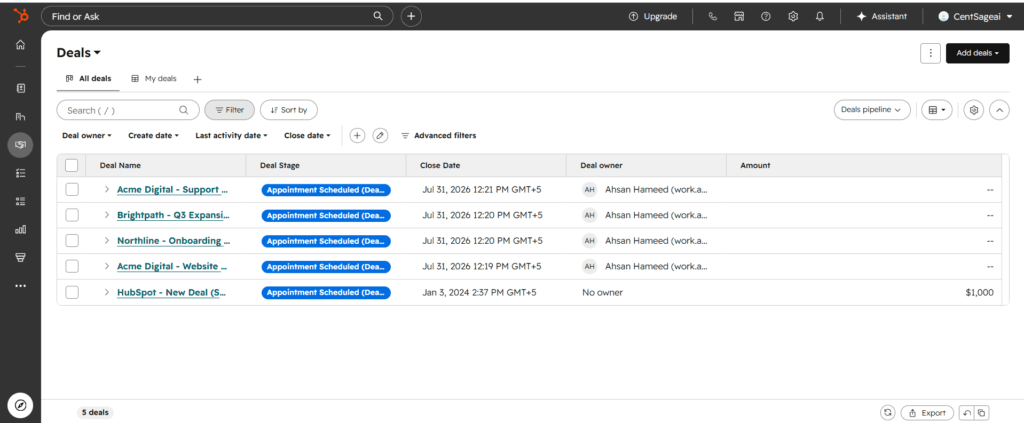
Here is the tension the title of this article forces: the free tier is capped at two users. For a five-person agency, that means the free CRM covers the one or two people who actually touch sales — and the moment all five need seats, you are on Starter at minimum. At $7 per seat annual, that is a painless $35 a month. The real gravity is the next jump: Starter to Professional is $7 to $90 per seat annual — roughly thirteen times — or $20 to $100 monthly, five times, and Professional adds a mandatory $1,500 one-time onboarding fee that is not in the per-seat number. HubSpot free is a genuinely good on-ramp; just know the road it is an on-ramp to.
Pipedrive — paying for predictability
Pipedrive makes the opposite bet: no free tier, and in exchange, no cliff. Lite at $14 per seat annual puts five people at $70 a month, and the next tier up — Growth at $24 — is a step, not a leap. The product is deals-only on purpose: pipeline, activities, follow-ups, and very little else, which for an agency that wants a CRM rather than a marketing platform is a feature. The honest tradeoff is simply that you pay from day one. If the two-user free ceiling makes HubSpot awkward for your team, Pipedrive’s flat math is the predictable alternative.
Close — when calling is the job
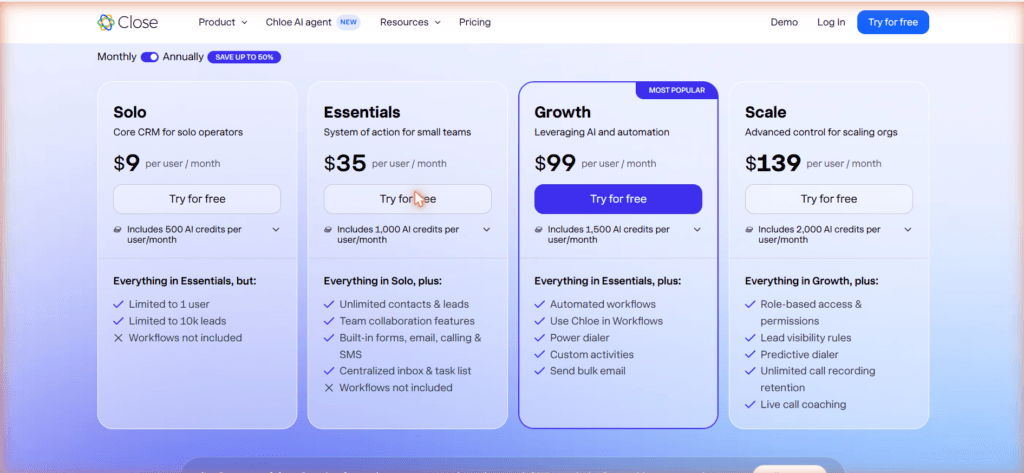
Close is built for teams that live on the phone — its calling, SMS, and inbox tooling are the product, and its pricing says so. The $9 Solo tier looks like a base tier and is not one: it is capped at one user, stated right on the pricing card. The real team floor is Essentials at $35 per seat annual — $175 a month for five — which buys built-in calling that the other two charge extra or integrate externally for.
One more line from the pricing card that matters for readers of this site: workflows are not included on Solo or Essentials — the card marks them excluded on both, so automation workflows inside Close start at Growth, $99 per user per month. If automating your CRM is part of the plan, the real Close price for you is not $35.
A practical warning while you are on their pricing page: check the billing toggle before comparing numbers — the figures shown default to annual billing, and reading them as monthly prices makes Close look cheaper than it is. For a project-based agency that mostly emails and meets, Close’s premium buys tooling you will not use; for an outbound shop making forty calls a day, it is the only one of the three built for the job.
The automation question
If you have followed our tutorials, your agency already runs workflows in Make or n8n — so which of these CRMs plugs into that plumbing? I typed all three names into each platform’s own integration search on July 18, 2026. HubSpot: one app in Make, and in n8n both a HubSpot node and a HubSpot Trigger. Pipedrive: three results in Make including the main Pipedrive CRM app, and in n8n a Pipedrive node plus a Pipedrive Trigger. Close: one app in Make — and in n8n, nothing. Typing Close into n8n’s integration search returns zero integrations and an End of results message. Not a thin integration — none, by the platform’s own index.
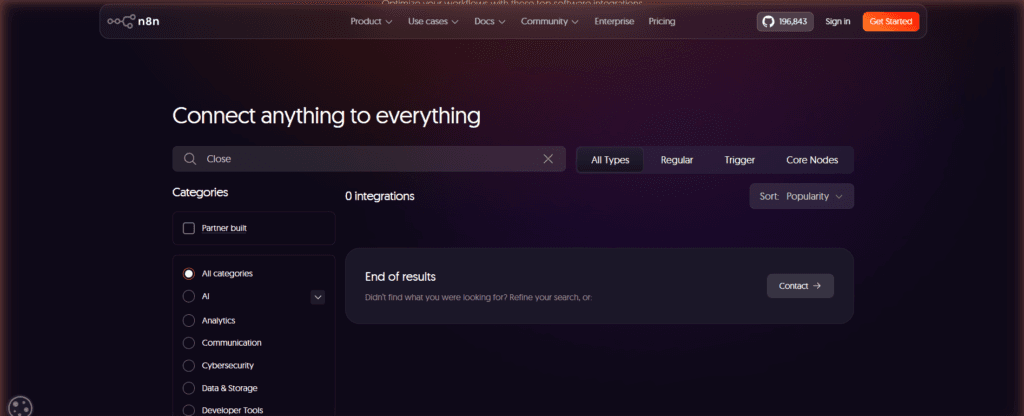
For a team standardizing on n8n — including the workflows from our n8n form submission guide — that single search result is close to disqualifying for Close: connecting it would mean generic HTTP requests against their API rather than a supported node. HubSpot and Pipedrive both connect first-class to the automation stack this site teaches, and that, as much as any pricing line, is why they are the realistic pair for most readers here. Our automation tool comparison covers the platform side of this same question.
The verdict, by situation
- Coming from a spreadsheet, cost-sensitive, and only one or two people touch sales: start on HubSpot free — it is real software at zero cost — with eyes open about the two-user cap and the Starter-to-Professional cliff behind it.
- All five need seats and you want to know what next year costs: Pipedrive Lite. $70 a month, flat structure, deals-only focus, and first-class connections to Make and n8n.
- Outbound calling is the business: Close Essentials — and budget for Growth if you want workflows, because that is where they start.
- And the rule that outranks the matrix: the CRM your team actually updates beats the one with the best feature list. Pick the one whose daily use feels lightest to your five specific people.
The honest limitations
Hands-on depth here is HubSpot-only — our deal tracking genuinely lives there, while Pipedrive and Close are assessed from verified pricing and documented capability, not daily use. That is the honest scope of this piece. Pricing moves constantly: every figure was checked July 18, 2026, one tier had been renamed since our own research notes were written, and you should re-verify before signing anything. And this is a five-person services-agency lens throughout — at twenty seats, or in e-commerce, the math and the verdicts both change. If you have not audited what your team already pays for before adding a CRM to it, our stack audit is the place to start.