
The voice platform decision that isn’t just about price
When an agency decides to deploy conversational AI voice agents, evaluating platforms purely on headline per-minute rates leads to severe operational miscalculations. In our after-hours voice intake build, a live test call exposed a $0.05/minute gap between itemized provider costs and the dashboard total. That discrepancy highlighted a fundamental reality of the voice AI market: headline rates rarely reflect the total cost of ownership.
Beyond raw compute and model pass-through fees, agency owners must account for non-model hosting charges, developer control interfaces, reseller options, and telephony carrier integrations. Selecting the right platform requires evaluating structural architecture and operational fit rather than picking the vendor with the lowest advertised sub-cent marketing claim.
What each platform actually is
- Vapi (developer-first orchestration layer): a low-latency developer platform giving granular control over individual voice pipeline components (STT, LLM, TTS). Acts as an orchestration API and dashboard, letting agencies assemble a custom provider stack.
- Synthflow (no-code and agency workflow platform): a visual, prompt-driven workspace built for agencies and non-technical operators, emphasizing drag-and-drop agent building and native workflow integrations, alongside a reseller framework that’s currently changing.
- Retell AI (developer-first voice infrastructure): an API-centric voice engine focused on performance and transparent component-level pricing, offering both state-machine conversation flows and single-prompt agents with live cost/latency metrics in the editor.
Vapi — Developer-first orchestration & the resolved platform fee
Architecture and developer control
Vapi provides control over every layer of the voice processing stack. This site’s own build paired a Deepgram Nova 3 transcriber with an OpenAI GPT-4o Mini language model and Vapi’s own “Elliot” voice, with parameters like responsiveness and silence timeouts configurable per assistant.
Pricing structure and the resolved Article 26 gap
In our initial after-hours voice intake build, a test call logged an itemized provider cost of $0.04/minute (Deepgram + GPT-4o Mini + Vapi Elliot Voice) against a final billed dashboard rate of $0.09/minute.
That gap is now resolved, confirmed directly on Vapi’s own pricing page: Vapi charges a separate $0.05/minute “Vapi Hosting Cost,” listed as volume-based, that excludes model provider costs entirely and is billed on top of them. Combined with the $0.04/minute BYOK itemized stack, that lands exactly on the $0.09/minute dashboard total observed during testing.
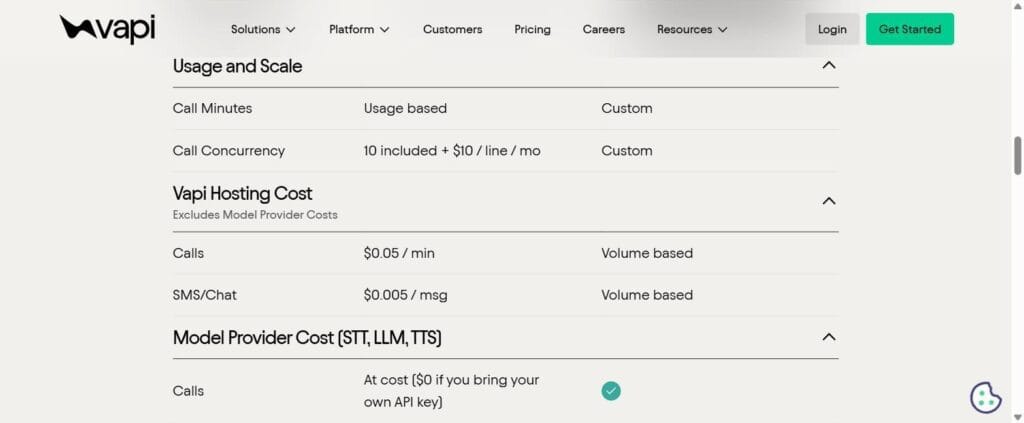
Vapi’s pricing page — the “Vapi Hosting Cost” line, separate from model provider costs
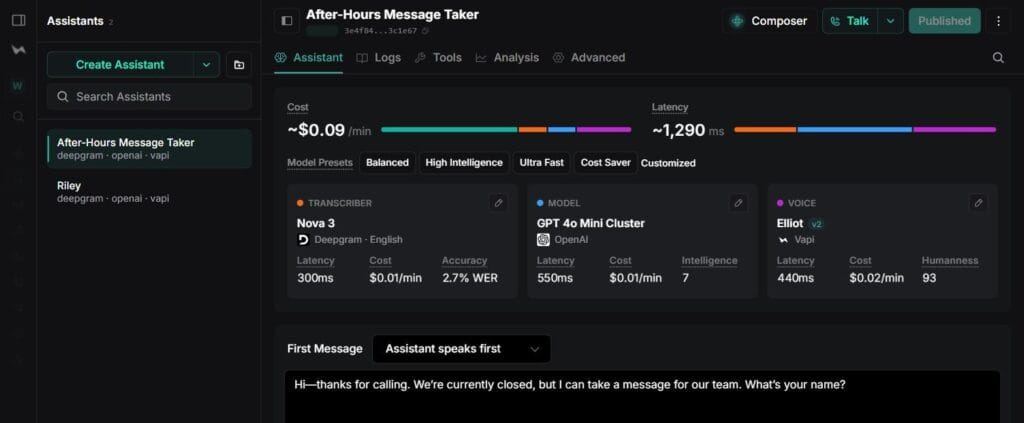
The same assistant from Article 26 — $0.09/min total, itemized stack shown below it
Builder UI and execution model
Vapi uses a single-assistant configuration screen — Transcriber, Model, and Voice cards, each with their own latency/cost/quality stats, sitting above a system prompt editor. Developers attach a Server URL for webhook delivery to tools like Make.com or HubSpot, the same pattern used in Article 26’s build.
Synthflow — No-code agency building & the reseller transition
Architecture and visual workflow editor
Synthflow targets agency owners who want to build and deploy voice agents without writing API code. Its Agent Editor combines a visual prompt panel supporting dynamic token variables (such as {X-Customer-Name}) with global settings for language, LLM model, timezone, and voice.
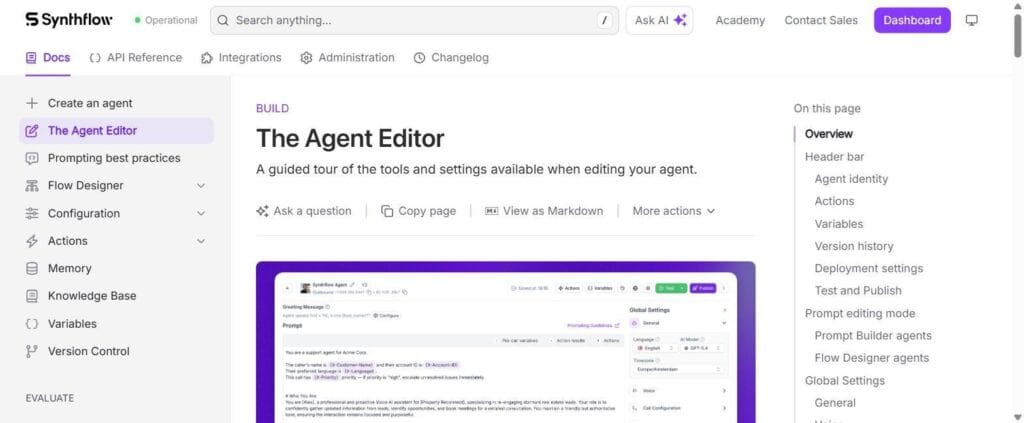
Synthflow’s own docs — the Agent Editor, prompt panel and global settings
Dated pricing and enterprise status
Synthflow’s pricing picture is only partly settled as of this research pass:
- Enterprise tier (confirmed): contracts start at $30,000 annually, scoped around concurrency, custom SLAs, dedicated telephony, and security compliance.
- Pay-as-you-go / self-serve tier (unconfirmed): third-party pricing guides describe an active self-serve PAYG tier starting around $0.08–$0.14/minute, and Synthflow has historically run subscription tiers (Starter, Pro, Growth). It’s not clear whether a self-serve card currently sits alongside the Enterprise option on Synthflow’s own pricing page — check their pricing page directly before assuming it’s still offered.
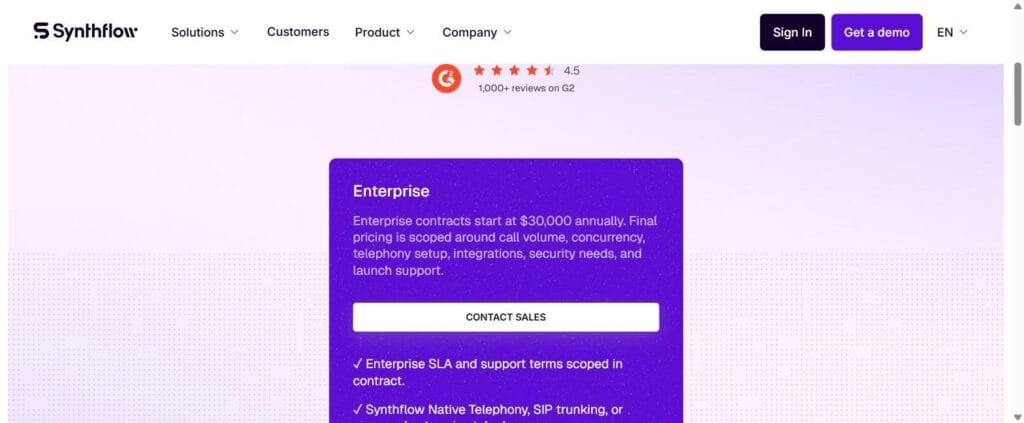
Synthflow’s pricing page — the confirmed Enterprise card, $30,000/year
Crucial operational update: September 2026 reseller sunset
For agencies evaluating Synthflow specifically to white-label and mark up voice AI services to sub-accounts, this is worth knowing before you commit: Synthflow’s own documentation confirms that native in-product client reselling and sub-account billing is being removed on September 15, 2026.
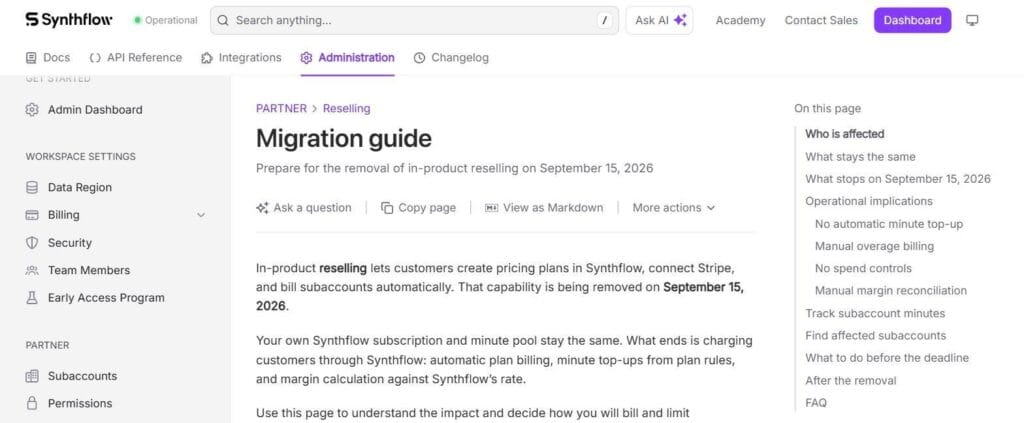
Synthflow’s own migration guide — in-product reselling removal date, confirmed
Your own subscription and minute pool are unaffected. What ends is charging clients through Synthflow itself — automatic plan billing, minute top-ups from plan rules, and margin calculation against Synthflow’s rate. Agencies using this feature will need to move client billing to an external system.
Retell AI — Infrastructure-first transparency & modular flows
Architecture and builder UI
Retell AI positions itself as developer-first infrastructure. Its editor supports two agent architectures — Single Prompt Agents for simple intake flows, and node-based Conversation Flows for multi-turn decision trees — with live latency, token, and per-minute cost stats shown directly alongside the prompt configuration.

Retell’s pricing page — “true pay as you go,” no annual contract required
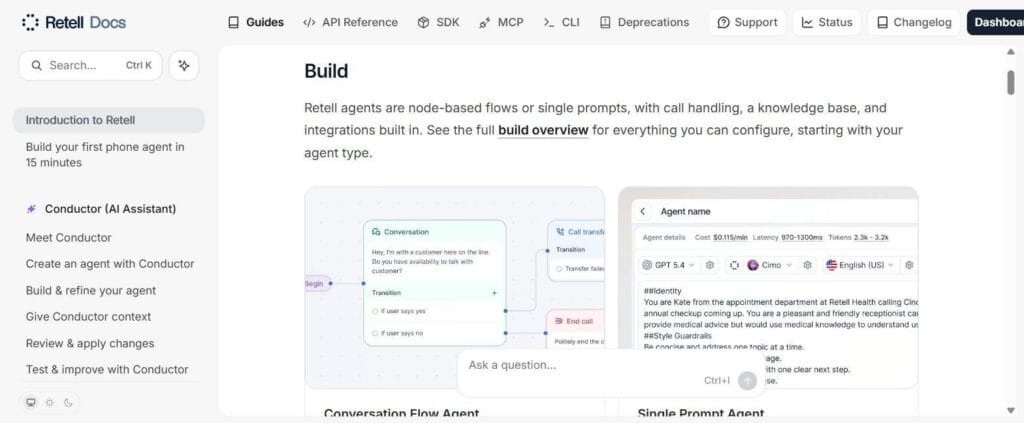
Retell’s own docs — Conversation Flow and Single Prompt Agent views, live cost/latency/token stats
Dated pricing and the live calculator breakdown
Retell avoids monthly subscription platform fees, running entirely on pay-as-you-go billing. Its live public “Estimate Your Cost” calculator, for an inbound agent at 100 monthly calls on GPT-4.1, breaks down as:
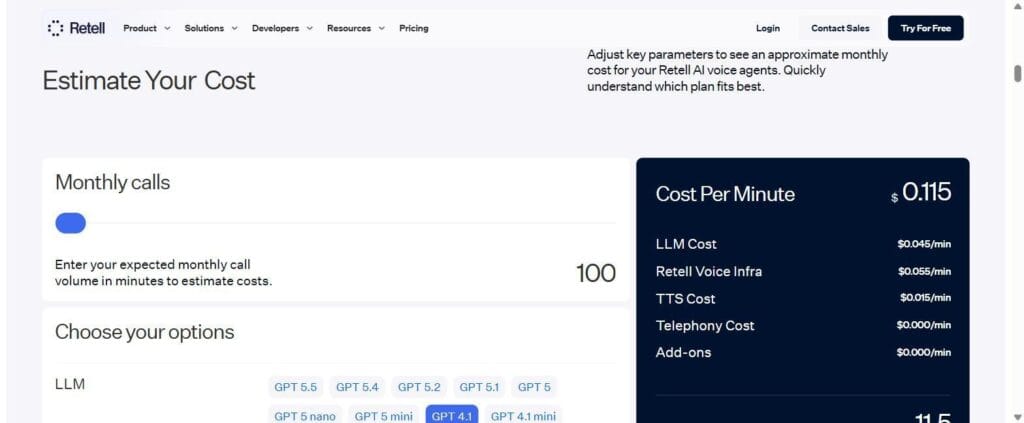
Retell’s live public cost calculator — itemized breakdown, no login required
LLM Cost (GPT-4.1): $0.045 / minute
Retell Voice Infra: $0.055 / minute
TTS Cost: $0.015 / minute
Telephony Cost: $0.000 / minute
—————————————-
Total: $0.115 / minute
The “Retell Voice Infra” charge
Retell’s $0.055/minute “Retell Voice Infra” line functions much like Vapi’s hosting fee — a non-model infrastructure charge sitting alongside LLM and TTS costs. The meaningful difference is disclosure: Retell shows this openly on its public calculator with no login required, while Vapi’s hosting fee sits on a separate section of its pricing page rather than the in-dashboard assistant cost card.
Side-by-side comparison table
| Feature / Dimension | Vapi | Synthflow | Retell AI |
| Primary category | Developer orchestration layer | Visual no-code agency platform | Developer voice infrastructure |
| Pricing model | Pay-as-you-go + BYOK | Enterprise confirmed ($30K/yr); self-serve PAYG pricing not independently verified | Pure pay-as-you-go, no base subscription |
| Base infrastructure fee | $0.05/min “Vapi Hosting Cost,” listed volume-based | Not itemized separately in what’s confirmed so far | $0.055/min “Retell Voice Infra” |
| Itemized cost transparency | Yes — STT, LLM, TTS, and hosting all shown | Partial — prompt/config panel shown, no confirmed live cost card | Yes — live public calculator |
| Typical all-in cost | ~$0.09/min confirmed on this site’s own build | ~$0.08–$0.14/min per third-party sources, not independently verified | $0.115/min confirmed at 100 calls/mo, GPT-4.1 |
| Reseller / white-label | Not marketed | Included, but in-product billing sunsets Sept 15, 2026 | Not found on public pages |
| Builder architecture | Single-assistant config: Transcriber/Model/Voice cards + prompt | Visual prompt panel + global config, template gallery | Single-prompt or node-based conversation flow |
| Evaluation method | Live hands-on build (Article 26) | Platform docs and marketing pages | Platform docs and public calculator |
Which one fits your use case
Scenario A: Your agency is building internal automation tools (e.g., after-hours intake)
If your primary goal is automating your agency’s own lead capture or phone triage, Vapi is the established recommendation here — as demonstrated in our after-hours voice intake deployment, its single-assistant architecture pairs cleanly with Make.com webhooks, with full component-level cost visibility once you know where to look for the hosting fee.
Scenario B: Non-technical teams wanting visual drag-and-drop workflow design
If your team lacks developers and prefers a visual interface to build and maintain voice agents, Synthflow offers the gentlest learning curve of the three.
Critical deadline: if you plan to use Synthflow’s native white-label reseller and client billing features, in-product billing is being sunset on September 15, 2026. You’ll need an external invoicing system — see our agency billing platform comparison — to handle client payments going forward.
Scenario C: Developers requiring complex, multi-turn conversation logic
If you’re building branching voice applications — multi-step booking, structured intake with many conditional paths — Retell AI’s node-based conversation builder and transparent public cost calculator make it a strong fit for engineering-led teams.
The honest limitations
First, testing a voice builder via documentation differs from live call deployment. Vapi was tested end-to-end via a live WebRTC call and Make.com execution in Building an AI Voice Agent for After-Hours Client Intake; Retell and Synthflow are evaluated here from official documentation, marketing pages, and public calculators rather than a hands-on build — the comparison table above notes this explicitly for each platform. Real-world testing would still be needed to judge audio latency and turn-taking under load for the other two.
Second, telephony charges sit outside all three of these per-minute figures. Every rate above covers voice processing, transcription, and LLM reasoning — connecting to an actual phone line still requires a carrier (Twilio, SignalWire, Telnyx or similar), adding roughly $0.01–$0.02/minute plus number rental on top of whichever platform you choose.
Finally, voice AI pricing and reseller policies are moving targets in this category — Synthflow’s own reseller mechanism is changing on a specific date as this article is being written. Per our 90-day SaaS audit framework, revisit this comparison on a similar cadence rather than treating any of these figures as fixed.
